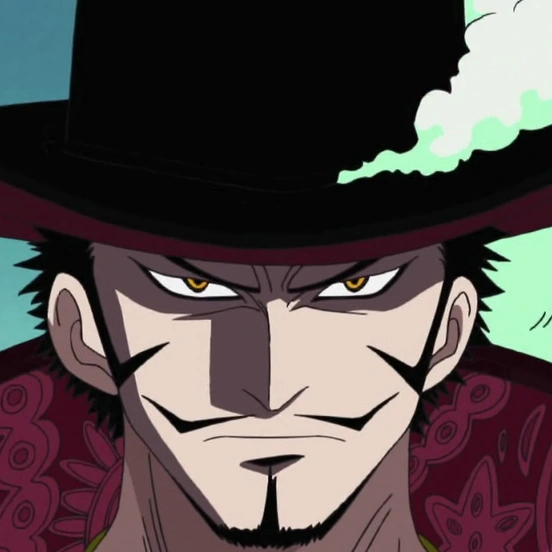
TL;DR: Dracule Mihawk — "Hawk-Eyes" — holds the official title of World's Greatest Swordsman. He carries Yoru, one of the twelve Supreme Grade blades and one of the few confirmed black blades in the series. He has no Devil Fruit. His power comes entirely from swordsmanship and Haki. He trained Zoro for two years during the timeskip, and is the man Zoro has to surpass to complete his goal. He is also the reason that goal is interesting.
The Title and What It Means
"World's Greatest Swordsman" is a formal title in One Piece — not a reputation, not a street ranking. It means Mihawk is acknowledged as the best. The Marines know it, the Warlords knew it, the World Government tracked it.
He held that title as a Warlord of the Sea, which meant the government tolerated him in exchange for occasional cooperation. After the Warlord system was abolished post-Levely, his bounty was reinstated at 3.59 billion berries — among the highest confirmed bounties in the series, placing him in the tier of former Warlords and approaching Yonko territories. He joined Cross Guild — the organization nominally under Buggy, practically co-run by Mihawk and Crocodile — which now puts bounties on Marines rather than pirates.
The title itself is load-bearing for Zoro's arc. Zoro's oath to Kuina was to become the world's greatest swordsman. The moment Zoro met Mihawk and lost — completely, decisively, with Mihawk using a knife smaller than Yoru while Zoro used all three swords — the series locked in exactly who stood at the top and what reaching it would require.
Yoru
Yoru is one of twelve Supreme Grade swords, the highest tier in One Piece's blade classification. It is a black blade — one of the rarest sword states in the series, achieved by permanently infusing a blade with Haki until the steel itself transforms in color and composition. Only a handful of confirmed black blades exist in the story.
The mechanism for creating a black blade matters to Zoro's own arc: his current sword Enma actively draws Haki from its wielder, forcing constant Haki output just to control it. Wano makes it explicit that if Zoro can generate enough Haki to fully control Enma — to "tame" it — he will have produced the conditions for turning Enma black, the same way Mihawk turned Yoru black. The sword is already worthy of being Supreme Grade. It needs a user worthy of completing the transformation.
Yoru is large enough that Mihawk wears it across his back. In his hands it looks proportionate. Against anyone else it would be a landscape feature.
Mihawk uses Yoru with economy. He doesn't swing wide or posture. The cuts are precise, minimal, and final. At Marineford, he cut a tsunami that Whitebeard generated — a wall of water dozens of meters tall — simply by slashing through it. He said he was just clearing the path to find Whitebeard's location. That was not the point of the demonstration.
The Shanks Rivalry
Before Shanks lost his arm — before the Straw Hats existed, before the current Yonko arrangement solidified — Mihawk and Shanks clashed repeatedly. The duels were legendary enough that the seas literally shook. Neither killed the other.
When Shanks lost his arm to the Sea King protecting Luffy, Mihawk stopped seeking him out. He said as much directly when they met at Marineford: fighting a one-armed Shanks held no interest for him. The rivalry required both of them whole.
This detail matters for Zoro's goal. The man Zoro has to beat trained in combat against someone who is now a Yonko. Mihawk's baseline is that register. When Shanks eventually regains interest in resolving their rivalry — or when the endgame requires it — whatever comes of that fight will reframe what Mihawk's title actually represents.
The series has kept their relationship as one of mutual acknowledgment. Shanks appeared at Marineford, Mihawk was present. They spoke briefly, without hostility, as two people who understand each other's caliber in a way most of the world doesn't.
The Baratie Fight
Mihawk arrived at the Baratie — the floating restaurant — having just cut Don Krieg's fleet in half crossing the Grand Line. Not as an aggressive act. He was bored, and it was in his way.
Zoro challenged him immediately.
Mihawk fought with a cross-shaped pendant knife — a piece of jewelry he wears around his neck, barely the length of a hand. He let Zoro use all three swords. He blocked, redirected, and dissected Zoro's technique with a secondary weapon before finally reaching for Yoru.
He cut Zoro across the chest and stopped before killing him — because Zoro refused to retreat and refused to turn his back. Mihawk acknowledged that and let him live. His exact words: "You are still green, but the color of your ambition — that is real." The wound left a permanent scar that runs diagonally from shoulder to hip. Zoro kept it deliberately, as a reminder of the distance between them and how far he has to close it.
What Mihawk recognized in that fight wasn't Zoro's current ability — which was nowhere near his level. It was the direction. Zoro wasn't performing for a crowd or fighting out of anger. He was fighting with the specific intent of measuring the gap so he could close it. Mihawk respects that orientation. He encounters it rarely.
The Lone Castle on Kuraigana
Mihawk lives alone on Kuraigana Island — a ruined island populated by Humandrills, baboons that learned combat by watching human soldiers fight during a war that ended generations ago. The island's human population is gone. Mihawk stays there because it suits him: no visitors, no obligations, no audience.
He is not a social creature. He has no visible allies outside Cross Guild, no crew, no apprentices. He occasionally visited Shanks. He occasionally attended Shichibukai meetings. His engagement with the rest of the world is entirely on his own terms, and the terms are minimal.
This isolation is not weakness. It is a consistent expression of someone who has no use for the things that drive most fighters — recognition, territory, crew loyalty. His drives are singular: the sword, the standard, and whatever comes of meeting someone who can actually challenge it.
Two Years on Kuraigana Island
During the timeskip, Zoro arrived at Kuraigana Island. He asked Mihawk to train him. The request required swallowing every piece of pride Zoro had, in front of the man he had publicly sworn to defeat, after losing to him completely.
Mihawk agreed, on the condition that Zoro survive the island's Humandrills first.
Two years of training under the world's greatest swordsman produced a Zoro who could cut steel ships with casual Haki infusion, had unlocked advanced Armament Haki techniques, and had the foundations of Conqueror's Haki infusion that he'd develop at Wano. The Baratie fight was one-sided. The post-timeskip Zoro can cut Doflamingo, match King, and run Conqueror's coating on his blades.
Mihawk is not warm about it. He didn't take Zoro on out of affection. He trained him because watching someone develop at that rate, aimed directly at you, is apparently interesting enough to spend two years on.
The arrangement also means Mihawk has more information about Zoro's ceiling than anyone else alive. He knows exactly where Zoro is and how far he has to go. Whether Mihawk has adjusted his own training in response to what he's seen is unaddressed by the series — but the implication is there.
No Devil Fruit
This is worth stating explicitly because One Piece's power system defaults to fruit users. Mihawk has none. His dominance is built on swordsmanship, Haki, and the decades of combat experience required to hold the title against everyone who's tried to take it.
The implication for Zoro: the path to the top doesn't require a fruit. You do have to be Mihawk-level, which is its own problem. But the ceiling is reachable without a shortcut.
Most of the series' top-tier fighters have fruits. The World Government Admirals are Logia users. The Emperors have varying fruit abilities. Mihawk holds the top swordsmanship title on pure physical ability and Haki. Shanks similarly has no confirmed fruit. The two people Zoro aims between — his goal and his teacher — both built their tier without a fruit.
Cross Guild
After the Warlord system's abolition, Mihawk teamed with Crocodile to form Cross Guild — a counter-bounty operation that puts prices on Marine heads. The nominal leader is Buggy (by accident; Buggy's face appeared on the recruitment materials and the world assumed he was the organizer). The actual operational power is Mihawk and Crocodile.
Cross Guild has Emperors-tier bounties attached to it now. Mihawk's 3.59 billion and Crocodile's own bounty, combined with whatever Buggy's inflated reputation contributes, makes it one of the more unusual power structures in the Final Saga. The World Government has to issue bounties for a former Warlord who spent years under their umbrella — while he watches from his castle and waits for whoever is coming.
FAQ
Does Mihawk have a Devil Fruit? No. He has no Devil Fruit. His power comes entirely from Haki, swordsmanship, and Yoru. This makes him one of the most notable fruit-free fighters at the top of One Piece's power structure.
Why did Mihawk train Zoro? Zoro arrived at Kuraigana Island and asked. Mihawk agreed — his stated reason was that he wanted to see how far someone aimed directly at him could grow. The practical answer is that Mihawk respects genuine ambition backed by the ability to survive.
Is Mihawk stronger than Shanks? Unresolved by the series. The formal title of World's Greatest Swordsman puts him above Shanks in swordsmanship specifically. Their rivalry was described as even before Shanks lost his arm. A direct comparison remains one of the story's open questions.
What is Yoru? A Supreme Grade black blade — one of twelve weapons at the top of One Piece's sword classification. Black blades are rare; achieving the transformation requires permanently infusing Haki into the steel. Yoru is the most famous confirmed example.
Will Zoro beat Mihawk? The series has committed to Zoro's goal since chapter one. Whether it happens in the Final Saga is unconfirmed, but the narrative is structured around that confrontation being the endpoint of Zoro's arc.
