
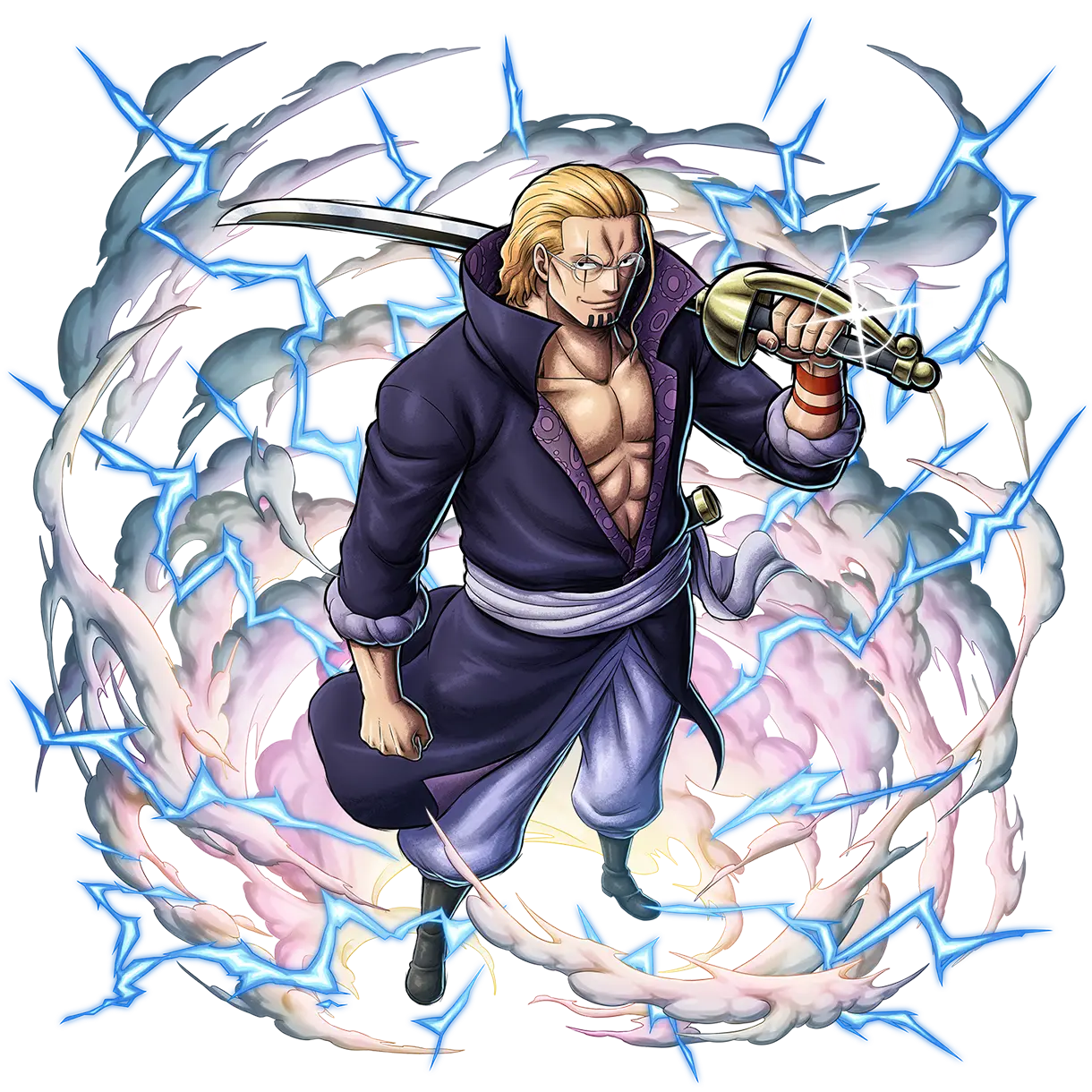
TL;DR: Silvers Rayleigh served as first mate on the Oro Jackson under Gol D. Roger — the closest person to the Pirate King, present at Laugh Tale, present when the world's most important secret was discovered. After Roger's execution he disappeared into a quiet life at Sabaody Archipelago, coating ships and gambling away whatever he earned. Then Luffy arrived. Rayleigh spent the next two years on a deserted island teaching him Haki from the ground up. By his own admission he is past his prime. The series has never shown what his prime actually looked like, and that gap is intentional.
How the Partnership Started
Rayleigh met Roger by chance. Roger had just broken into a warehouse and was stealing food. Rayleigh owned the warehouse. What might have been an arrest or a fight turned into a conversation — and by the end of the conversation, Rayleigh had decided to follow this man wherever he was going.
He was young and, by his own description, had nothing left to lose. His family was gone. He had no particular destination. Roger's certainty about what he wanted was the thing that settled it: here was someone who knew exactly what he was looking for.
That first impression held for everything that followed. Rayleigh describes the Roger Pirates' voyage as the most fulfilling period of his life without qualification. Not the treasures, not the notoriety, not the fights — the act of sailing toward something with people who had fully committed to reaching it.
Roger named him first mate. In practice this meant Rayleigh was the executive officer of the most powerful pirate crew in the world — managing operations, deploying crew in battle, coordinating the logistics of a voyage that eventually took them to every corner of the Grand Line. Whatever Roger decided, Rayleigh was the person who made it actually happen.
What He Knows
Rayleigh was present at Laugh Tale. He stood in the same room as Roger when Roger found the One Piece and discovered what Joy Boy had left behind. He heard Roger cry and then laugh. He understood what the message meant.
He is, accordingly, one of a handful of people alive who knows the truth — not approximations of it, not theories about it, but the actual fact of what's at the end of the Grand Line and what it requires.
When Robin arrives on Sabaody, Rayleigh meets her directly. He tells her he could explain everything. He then explains why he won't: the Roger Pirates found the answers and couldn't do anything with them. They were born too early. If Robin — and through Robin, Luffy's crew — discovers the truth through their own journey, they'll be equipped to use it in a way the Roger Pirates weren't.
This is either profound wisdom or convenient avoidance, and the series leaves it genuinely ambiguous. What matters is that Rayleigh has the answer and chooses not to give it. Every person who reaches Laugh Tale will find it themselves.
After Roger Died
Roger turned himself in voluntarily. He was dying from illness — the disease that had been killing him slowly for years — and chose to stage his own execution in a way that might ignite the Great Age of Pirates rather than end piracy with a simple death.
His final words, publicly broadcast: "My treasure? I left it all in that place."
The plan worked. It worked so thoroughly that Rayleigh, by the time the series begins, seems to have made peace with an outcome he had no part in controlling. He watched his captain die, watched the world set off hunting the One Piece, and went quiet.
He ended up at Sabaody Archipelago — the last major island before the Grand Line's second half, where all ships headed for the New World need to be coated to dive beneath the Red Line. He became a ship coater. He gambled. He drank. He worked on the margins of the world where the most powerful pirates in the next generation would pass through.
Whether he was waiting or simply living is a question the series doesn't answer.
Sabaody
The Straw Hats arrive at Sabaody and immediately create a crisis — a crew member is kidnapped by a Celestial Dragon, Luffy punches the Celestial Dragon in response, and the World Government dispatches Admiral Kizaru to handle the fallout.
Kizaru is a Logia user. His Devil Fruit, the Pika Pika no Mi, makes him light itself. He moves at light speed, fires lasers, and is essentially untouchable without advanced Haki. The Straw Hats at Sabaody don't have advanced Haki. He walks through them.
Rayleigh appears. He fights Kizaru directly — rusty, out of practice, old — and the fight goes even enough that Kizaru can't pursue the Straw Hats. Sentomaru, the Admiral's aide, remarks that capturing Rayleigh would have been a larger incident than the Celestial Dragon situation they were already managing. Kizaru lets it go.
What that exchange establishes: a retired, gambling-addicted old man who hasn't fought seriously in decades can neutralize a Marine Admiral. The series does not try to resolve the math on what this means for his prime.
Two Years on Rusukaina
Kuma scatters the Straw Hat crew across the world. Luffy ends up on Amazon Lily, processes what happened, and eventually receives Rayleigh's message through Jinbe: two years, the abandoned island of Rusukaina, full Haki training.
Luffy goes.
Rusukaina is genuinely dangerous — populated by creatures strong enough to kill a Yonko-tier fighter if encountered in the wrong circumstances. Rayleigh uses the environment deliberately: he's not just teaching theory, he's forcing Luffy to develop practical Haki under pressure. The creatures on the island provide the kind of opponent no artificial training scenario could replicate.
The curriculum, broadly:
- Observation Haki (Kenbunshoku): sensing intent, presence, and the invisible movements of opponents. The foundation of combat awareness at the New World level.
- Armament Haki (Busoshoku): coating the body and weapons in Haki to bypass Logia defenses and land blows on Devil Fruit users. Essential against any serious opponent post-timeskip.
- Conqueror's Haki (Haoshoku): Luffy already demonstrated this involuntarily. Rayleigh focuses on teaching him not to suppress it — to recognize it as a weapon rather than a liability.
The two years on Rusukaina produce the post-timeskip Luffy: a fighter who can engage Admirals, whose Conqueror's Haki has enough output to paralyze high-level opponents, and whose Observation Haki is developed enough to read intent. None of this existed before Sabaody.
Rayleigh specifically chose not to teach him everything. He told Luffy that a captain needs to develop the final stages himself, through actual combat experience — that teaching everything means producing someone else's version of strength, not Luffy's own. This is consistent with what he told Robin about Laugh Tale: the destination means more if you find it yourself.
By the end of the Wano arc, Luffy has surpassed what Rayleigh taught him by several orders of magnitude — Gear 5, Conqueror's Haki coating on his fists, combat abilities the series places at Yonko level. The foundation Rayleigh built is why those things were possible.
What Kind of Strength
Rayleigh doesn't have a Devil Fruit. He is, like Shanks, a pure Haki user — operating entirely through swordsmanship and Haki mastery rather than any supernatural ability.
This is a deliberate parallel the series establishes between Roger's two closest people. Roger himself reportedly had no fruit either. The highest peak of the Roger Pirates — the three people who reached Laugh Tale — were all Haki fighters who reached it without fruit augmentation.
What this implies about Haki's ceiling, separated from any Devil Fruit, is one of the questions the series hasn't fully answered. Rayleigh in his prime, at whatever level that actually was, is a data point the story keeps just out of view.
His weapon is a sword. His Haki output — even aged and out of practice — is enough to stop an Admiral. The gap between what he showed at Sabaody and whatever he was capable of at his peak during the Roger Era is the space the series uses to signal how much the old guard understood about power that the current generation is still catching up to.
The Relationship with Roger
Rayleigh loved Roger without reservation. He also knew exactly what Roger was — including the things that weren't easy to love.
Roger was terminally ill for the last years of his captaincy. He knew he was dying. He pushed the final voyage despite it, because reaching Laugh Tale was more important to him than dying quietly. He turned himself in knowing his execution would destabilize the world. Every major decision of Roger's last years was made in the shadow of knowing he wouldn't survive it.
Rayleigh was beside him for all of it. When Roger made the decision to turn himself in, Rayleigh opposed it — not because he thought it was wrong, but because he didn't want to lose his captain. Roger's response was the kind of thing that explains why Rayleigh followed him in the first place: he had already made the decision, and he was asking Rayleigh to trust him one last time.
He trusted him.
The world changed because of it. Rayleigh has spent the decades since living in the world Roger's death created, waiting — not urgently, but with the patience of someone who knows how long it takes for the right person to show up.
Luffy showed up.
FAQ
What is Rayleigh's bounty? Not currently revealed. After Roger's death he disappeared into obscurity at Sabaody. When he fought Kizaru, Sentomaru confirmed that capturing him would have been a major incident — implying the World Government considers him significant enough to track. His active-era bounty would have been enormous.
Why did Rayleigh coat ships at Sabaody? He says he ran out of money gambling. Whether this is genuine or a chosen obscurity isn't confirmed. He clearly retained the ability and willingness to act when it mattered.
Did Rayleigh know about the One Piece? Yes. He was at Laugh Tale. He knows everything Roger found. He tells Robin he could explain it all — and chooses not to, because the Roger Pirates found answers they couldn't use. He wants the next generation to find it themselves.
Can Rayleigh still fight at full strength? He was rusty at Sabaody by his own admission. He still matched Kizaru. What his prime looked like is something the series has never shown and seems deliberately unwilling to show.
Will Rayleigh appear in the Final Saga? He appeared briefly at the end of the Egghead arc, arriving at Sabaody as the Straw Hats fled. His role in the endgame hasn't been revealed, but the series hasn't retired him — which, given how deliberately his appearances have been placed, likely means something.
