
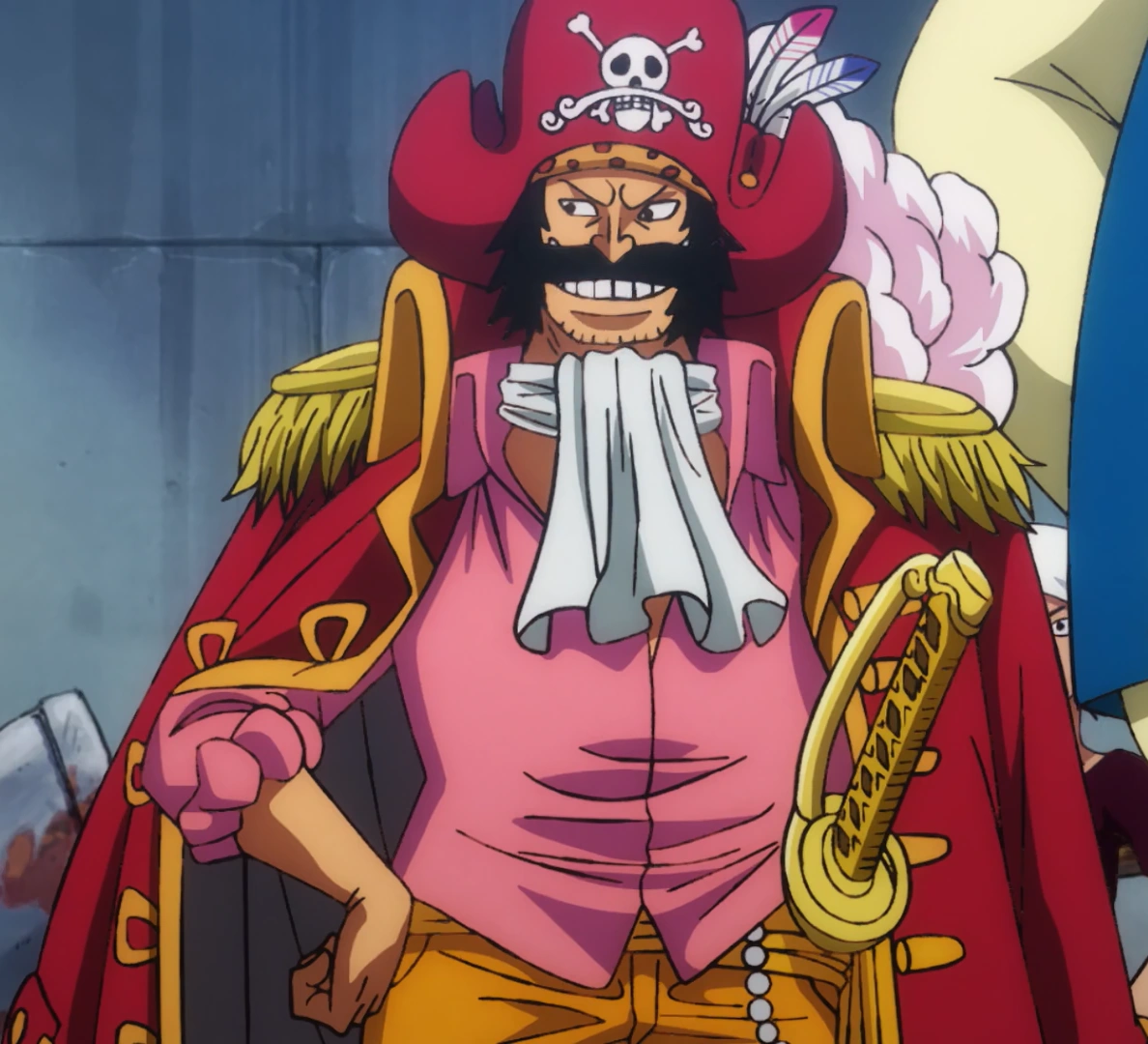
TL;DR: Gol D. Roger was executed at Loguetown before the first page of One Piece. He's been dead the entire time. Everything in the story is a consequence of that execution and the speech he gave before it. He found the treasure, learned the True History, and understood he was born in the wrong era to use either. Then he chose how to die in a way that started a new one.
He Died Before the Story Started
Roger was executed at Loguetown before chapter one. Everything in One Piece is a consequence of that — specifically of the final speech he gave on the scaffold.
The speech was short. He told the crowd his treasure was real and that he'd left it somewhere. The Golden Age of Pirates began the moment the blade came down.
Roger wasn't the most technically refined swordsman or the most strategically brilliant commander. What made him exceptional was will — a force his crew described as making the air itself feel different. His Conqueror's Haki was the most powerful the series has shown. He assembled a crew of legends and sailed toward something nobody believed existed.
He got there.
What He Could Do
Roger's combat is shown mostly in flashbacks and glimpses. What the series confirms:
His Haoshoku Haki was at the series' absolute ceiling. The clash with Whitebeard produced visible sky-splitting shockwaves — lightning discharge and environmental impact visible for miles. The two of them meeting in a clash of Conqueror's Haki is what the series establishes as the pre-timeskip high watermark for what Haoshoku looks like at full expression.
He also heard the Voice of All Things — a passive perception that let him understand the messages carved into Road Poneglyphs without being able to read them. Most scholars spent decades deciphering Poneglyphs through research. Roger listened. This is why the final voyage was possible. Oda links it directly to the Will of D. and to Joy Boy. Luffy can hear this voice too — it connected him to Zunesha at Zou and to the Sea Kings at Fishman Island. The ability isn't exclusive to Roger, but it is rare.
His swordsmanship is confirmed as comparable to Whitebeard's — they fought with both weapons and fruit-enhanced abilities across multiple encounters. No formal ranking places Roger above or below Mihawk because their time periods didn't overlap at the right moments. What the series implies: Roger was at a level where the question is academic.
The Illness
Roger's final years were shaped by an incurable disease. The nature of it is unspecified — the crew's doctor was Crocus, who joined specifically to manage Roger's condition and keep him functional long enough to make the final voyage. Without Crocus, Roger would have been bedridden far earlier.
The terminal diagnosis changed Roger's math. He knew he had a limited window. The illness wasn't a tragedy — it was a scheduling problem. He could either spend his remaining time in a slow decline or use it to finish what he started. He used it.
This is partly why the Roger Pirates disbanded immediately after Laugh Tale. The mission was done. The illness was progressing. Roger had no interest in leading a crew into the power vacuum after his death, no interest in fighting over territory. He spent the years left setting up what came after.
The Rocks Pirates and God Valley
Before the Roger Pirates existed as the dominant force, Roger and the Marine Vice Admiral Monkey D. Garp cooperated at the God Valley incident — one of the most significant events in One Piece's history that the World Government subsequently erased from all records.
The Rocks Pirates — captained by Rocks D. Xebec — were the most dangerous crew in the world. Crew included a young Kaido, a young Whitebeard, and a young Big Mom. Rocks himself was described as Roger's greatest enemy — the only person the series frames as meaningfully above Roger's generation in threat level.
At God Valley, Roger and Garp fought together to stop them. They succeeded. The World Government eliminated the records afterward because acknowledging God Valley would mean acknowledging Rocks D. Xebec, which would mean acknowledging that the government's power was stabilized by a pirate.
Roger survived. Rocks didn't. The Rocks Pirates dissolved. Their members — Kaido, Whitebeard, Big Mom — went on to become the Yonko of the next generation. The entire structure of the New World's power in One Piece's main story is downstream of what happened at God Valley.
The Crew
The Roger Pirates assembled at a specific time for a specific purpose and disbanded the moment it was done.
Silvers Rayleigh was first mate — the "Dark King," the most technically skilled fighter on the ship. He later settled in Sabaody and trained Luffy for two years during the timeskip. His presence as Luffy's teacher is a direct line from Roger to Luffy that the series marks explicitly.
Scopper Gaban was considered the second strongest crew member — largely absent from the story until the Final Saga, where he reappears on an island near Elbaf. His reappearance is a signal: Oda has been holding him back deliberately for the endgame, and whatever role he plays in it is connected to what Roger knew.
Kozuki Oden joined for the final voyage. His ability to read Poneglyphs was the key that unlocked the route to Laugh Tale — Roger could hear the Poneglyphs, but Oden could read them aloud so the full content could be understood and mapped. The combination of Roger's perception and Oden's scholarship is what made Laugh Tale reachable. Oden's death at Kaido's hands twenty years before the Wano Arc is central to the Wano Country Arc, but the wound goes back to this ship and what Oden learned on it.
Shanks and Buggy were cabin boys. Young enough that their time aboard Roger's ship is mostly backstory — but it's the backstory that explains everything about who both of them became. Shanks was present at Laugh Tale and knows what Roger found. Buggy was absent (sick with a fever) and has spent the rest of his life as a different kind of consequence of Roger's death.
Laugh Tale
In the last years of his life, Roger assembled the crew, located all four Road Poneglyphs, and sailed for the island at the end of the New World.
On Laugh Tale they found Joy Boy's treasure — the accumulated history of a civilization the World Government had spent 800 years erasing — and a letter Joy Boy left apologizing to Poseidon for a promise he couldn't keep.
Roger laughed. He wept. He said he had been born in the wrong era — that the person who would finish what Joy Boy started hadn't come yet. He named the island Laugh Tale because there was something absurd about arriving to an answer and not being the right person to use it.
What the treasure actually is remains one of the series' central mysteries. The series has confirmed it exists, that it involves Joy Boy's history, and that Roger considered himself the wrong person for it — implying the right person requires something he didn't have, or comes at a time that wasn't his. Luffy's Gear 5 awakening and Zunesha's declaration that Joy Boy had returned positions this as the answer to Roger's waiting.
The crew disbanded. Roger turned himself in. Before he did, he went to see Whitebeard.
The Last Visit
The conversation between Roger and Newgate — shown in flashback — is one of the few moments in One Piece where two characters who spent decades in opposition simply talk to each other as equals.
Roger was dying. He told Whitebeard he had found what he was looking for, and that it wasn't something he could do anything with alone — that the right era hadn't come yet. He acknowledged Newgate as someone who could have been Pirate King under different circumstances. This wasn't flattery. Roger didn't do flattery. He meant it the way he meant everything: directly, without softening it.
Whitebeard was the last person Roger said anything of substance to before walking into custody. The choice of who to say it to matters. This was Roger confirming to one of the only people who would understand that the thing he found at the end of the world was real, and that it was going to outlast both of them.
Garp and Roger
Monkey D. Garp is Roger's rival and the man who understood him best. They fought many times. Neither killed the other — by the time their rivalry concluded, both had the measure of the other without needing to finish it.
Roger's final request was personal: protect his unborn child. He asked Garp. Garp, despite everything — decades of opposition, the entire Marine career spent trying to capture him — agreed. He raised Ace alongside his own grandson in the same village. Roger never met his son. Ace carried Roger's blood as private shame until Marineford.
The fact that Roger's last request went to a Marine — and that Garp honored it — says something about what their rivalry actually was. It wasn't hatred. It was two people who had spent so long measuring each other that something like respect became inevitable.
Loguetown
The World Government planned the execution as a demonstration of authority. The Pirate King, publicly executed, the message being that no one escapes their reach.
Roger's final words:
"My treasure? If you want it, I'll let you have it. Look for it — I left it all at that place."
Every pirate in the world scrambled for the Grand Line simultaneously. The Golden Age of Pirates began not despite Roger's execution but because of it. The World Government got the opposite of what they intended.
Roger knew exactly what he was doing.
What He Left Behind
The deeper inheritance is harder to trace. When Roger reached Laugh Tale, he understood that he wasn't the one. The promise Joy Boy couldn't keep would need to be kept by someone not yet born. Roger's hope was that the right person would come.
Rayleigh stayed at Sabaody. Scopper Gaban waited elsewhere. Shanks watched and positioned carefully. All of them holding the knowledge of what Roger found until the right person arrived to use it.
When Luffy awakened his Devil Fruit against Kaido, Zunesha said: "Joy Boy has returned."
Roger knew what he was starting. He just wouldn't be there for the end of it.
FAQ
Did Roger actually find the One Piece? Yes. He reached Laugh Tale and found what Joy Boy left behind. The treasure exists. What it is — and why Roger didn't claim it for himself — is still one of the story's central open questions.
Why did Roger turn himself in instead of fleeing? The illness was terminal and the goal was done. A quiet death in a sickbed accomplishes nothing. A public execution at Loguetown, with final words broadcast to the world, starts a new era. Roger picked the version that mattered.
Is Luffy related to Roger? Not by blood. Luffy is Garp's grandson through Monkey D. Dragon. Roger's only known child is Ace, Luffy's adopted brother. The connection between Roger and Luffy is one of will and role — which the series treats as more significant than bloodline anyway.
What is the Voice of All Things? A passive perception that lets the user understand messages carved into Road Poneglyphs without reading the script. Roger heard them. Oden read them. Together, they could fully interpret every Poneglyph. Luffy can also hear this voice — it connected him to Zunesha and the Sea Kings.
Who were the Roger Pirates? Key members include Silvers Rayleigh (first mate), Scopper Gaban (second strongest), Kozuki Oden (Poneglyph reader), and cabin boys Shanks and Buggy. The crew assembled specifically to make the final voyage and disbanded immediately after Laugh Tale.
