
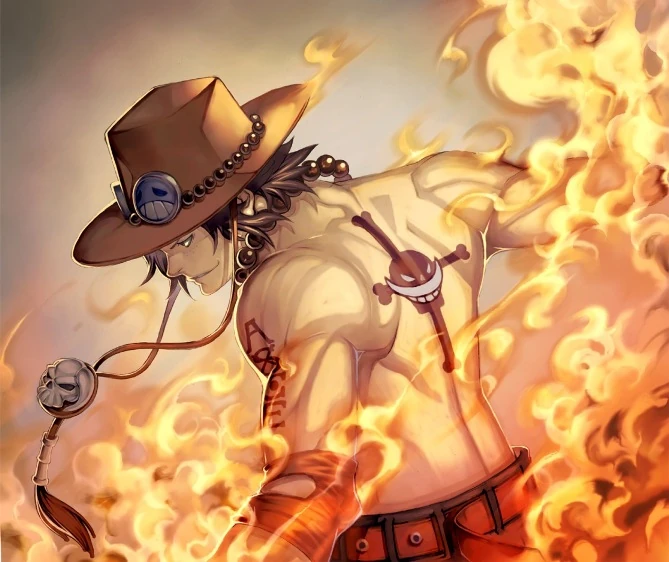
TL;DR: Ace was the 2nd Division commander of the Whitebeard Pirates, wielder of the Mera Mera no Mi, and Luffy's sworn older brother. He was also the biological son of Gol D. Roger, a secret he carried as private shame. His death at Marineford — after Luffy fought through an entire war to save him — is the moment One Piece stops being a story where the protagonist always gets there in time.
Who He Was
Portgas D. Ace, known as Fire Fist Ace, was the 2nd Division commander of the Whitebeard Pirates. Before that he led the Spade Pirates across the Grand Line and built enough of a reputation that Whitebeard defeated him in their first encounter and had him brought aboard the Moby Dick.
After Whitebeard defeated him, Ace was brought aboard the Moby Dick and proceeded to attack Whitebeard over a hundred times — daily assassination attempts that Whitebeard blocked without effort, and once fell asleep through entirely. Ace called that one a draw. Eventually the stubbornness broke. He joined anyway.
The thing that defined Ace wasn't the title or the strength. It was the reason he needed to prove himself at all. He was born the son of the Pirate King, and he hated it. He spent his entire life trying to become someone worth loving on his own terms, not by inheritance.
He mostly succeeded.
Portgas D. Rouge
Ace's mother's story runs before his begins.
Roger was going to be executed. The World Government knew Portgas D. Rouge was carrying his child. They expected a birth at normal term — roughly nine months after Roger's execution — and prepared accordingly. They would find Roger's child and eliminate the bloodline.
Rouge held Ace in her womb for twenty months. Not nine — twenty. She extended the pregnancy past any human biological limit, changing her body's chemistry to maintain the pregnancy while the World Government's search window closed. The physical strain was fatal and she knew it.
She survived long enough to name him, hold him once, and die.
She chose his name: Gol D. Ace, after Roger. But the name she wrote on the birth record was Portgas D. Ace — her own surname, not Roger's. A final act of protection, and a final act of love for a man she would name nothing after publicly.
Roger had asked Garp to protect the child. Garp honored it. He raised Ace alongside his own grandson in the same village, letting the two boys grow up together without telling either of them the full context. Garp believed in this enough to risk his career for it.
Three Brothers
Ace, Luffy, and Sabo grew up together in the Goa Kingdom — running through the Gray Terminal slums, swearing a brotherly oath over sake cups, planning to become pirates.
Goa Kingdom's class structure was brutal. The Gray Terminal was where the city's unwanted people lived and where its garbage was dumped. Ace, Luffy, and Sabo operated there freely, separate from the noble quarter that Sabo came from. Sabo's family was attempting to buy their way into Celestial Dragon nobility — they viewed his time with Ace and Luffy as contaminating. When a Celestial Dragon ship fired on the Gray Terminal as part of a planned "burning of waste," Sabo was shot at sea while trying to escape.
Sabo's apparent death left a mark that shaped Ace for years. His protectiveness over Luffy came from that loss. When he finally left to sea, he made Luffy promise to get stronger before following him. Their bond wasn't biology. It was a choice, made deliberately, renewed every day.
Ace learned the truth about his father as he grew older. He chose his mother's surname. He never stopped resenting the question — "does having Roger's blood make you a monster?" — even when the answer was obviously no. He asked Whitebeard, once, whether the world would have been better if he hadn't been born. Whitebeard told him he never should have been told otherwise.
The Mera Mera no Mi
Ace's Devil Fruit was the Mera Mera no Mi, a Logia that transformed his body into fire. His signature technique, Hiken (Fire Fist), launched a column of flame powerful enough to vaporize a ship in a single strike. He could fly by converting his legs to jets of fire, create walls of fire for defense, and his Logia body made most physical attacks phase through him.
His named techniques:
- Hiken (Fire Fist) — the column of flame he's named for; the technique he used to destroy an entire section of a fleet
- Enkai: Hibashira — a pillar of flame encircling the target
- Entei — a compressed orb the size of a small sun, Ace's most powerful confirmed attack
- Kyōkaen — a fire wall for defense and area denial
- Higan — rapid successive flame bullets
The fatal weakness was structural, not skill-based: Akainu's Magma-Magma Fruit generates heat that exceeds fire. Magma burns hotter than flame and neutralizes Ace's Logia properties on contact. This wasn't a gap in technique. It was physics, and there was no counter Ace could have developed.
The Spade Pirates and the Whitebeard Journey
Before joining Whitebeard, Ace captained the Spade Pirates — a crew he built himself, starting from nothing in East Blue and sailing the Grand Line. The Spade Pirates built a reputation fast enough that multiple factions, including Whitebeard, took notice.
Whitebeard defeated Ace in their first direct encounter and had him brought aboard the Moby Dick. What followed was Ace spending weeks launching daily assassination attempts — over a hundred in total — each of which Whitebeard blocked with casual ease. Once Whitebeard fell asleep in the middle of Ace's attack. Ace called that one a draw. Eventually, somewhere in those hundred-plus attempts, the dynamic shifted. Ace stopped trying to leave and started accepting that he was already home.
He became 2nd Division Commander. The crew treated him as family. This was the first time in Ace's life that belonging to something didn't feel like a debt or a question.
What Blackbeard Did
Ace hunted Blackbeard after Blackbeard killed a crewmate to steal his Devil Fruit. Thatch — 4th Division Commander, a member of the crew Ace considered family — was murdered. Ace refused to let it go unanswered.
He found Blackbeard on Banaro Island. He lost.
Blackbeard's Yami Yami no Mi cancelled Ace's Logia properties on contact. The darkness fruit neutralizes other Devil Fruit powers, which meant Ace's fire transformation could be bypassed. For a Logia user, this is the effective removal of the main defensive advantage. Blackbeard could be hit too, and he was — but he took the hits and kept going.
Blackbeard handed Ace to the World Government as a trade for a Warlord position. The Government announced a public execution. Roger's son, on the scaffold — the symbolism was intentional, and so was the broadcast.
Marineford
Luffy broke out of Impel Down with Boa Hancock's help, arrived at Marineford mid-battle after pushing his body past its actual limits, and fought through the war entirely on desperation. He had no plan beyond getting to Ace. He was going to die there and he knew it and he went anyway.
He got to Ace. He freed him.
Ace was free. The sea was right there.
Then Akainu said something about Whitebeard's legacy not being worth protecting.
Ace turned back. That decision is not a flaw in his character. It's the fullest expression of it — a person who couldn't hear his father figure insulted and keep walking, not after spending his whole life learning that Whitebeard's acceptance meant he was worth something. He turned back because that's who he was. He had fought for Whitebeard's honor a thousand times in a hundred assassination attempts. He wasn't going to stop now.
Akainu's magma fist went through his chest as he shielded Luffy.
Ace died in Luffy's arms thanking people for loving him. His last words were gratitude — for being born, for being loved, for a life that turned out to contain people willing to go to war for him.
The reason those words land so hard is that Ace spent his entire life afraid he didn't deserve them. He was Roger's son, and Roger's blood, in his mind, was a question mark hanging over whether his existence was a good thing. He asked it as a child. He kept asking it. Whitebeard's answer — calling him family, unconditionally — was the closest he got to settling it before Marineford.
He went out grateful. Oda made it impossible to be angry, because Ace wasn't. The character who feared his whole life that he had no right to exist died with the answer in his arms.
The Fallout
Luffy collapsed mentally. Not from wounds. Jimbei had to physically hold him together.
The two years Luffy spent training under Rayleigh trace directly to this moment. He understood, finally, that being strong wasn't enough. He had fought through an entire war and still lost the one person he came for. The timeskip isn't a power-up arc. It's grief turned into method.
Sabo, it turned out, had survived the Gray Terminal attack. He'd had amnesia for years — the trauma of being shot suppressed his memories of Ace and Luffy entirely. When he recovered his memories and learned Ace was dead, he entered the Corrida Colosseum in Dressrosa, won the Mera Mera no Mi, and awakened fire for the first time. Ace's fire didn't disappear. It passed to the person who grew up beside him.
A promise kept, one arc too late.
FAQ
Is Ace actually Roger's son? Yes. Oda confirmed it early in the story. Ace chose his mother's surname and kept his lineage private — not out of denial, but because he didn't want it to define him.
Why couldn't Ace beat Akainu? Magma is elementally superior to fire. Akainu's fruit generates magma — which burns hotter and overrides fire transformation. There was no version of that fight Ace could have won.
Could he have survived if he hadn't turned back? Possibly. They were meters from the sea when he stopped. The decision was his — not forced. Whether it was right or wrong depends on what you think a person owes the man who told them their life had value.
What happened to Ace's Devil Fruit after he died? The Mera Mera no Mi reincarnated and appeared as the prize in the Corrida Colosseum tournament at Dressrosa. Sabo won and ate the fruit. Ace's fire continues.
Who raised Ace? Monkey D. Garp, at Roger's request. Garp raised Ace alongside his own grandson Luffy in Foosha Village. Neither boy knew the full context of their connection until much later.
