Image: Unsplash.
Correction, October 15, 2026: the October 7 version used the press release's bill numbers (Int. 2602 and so on). Those were preconsidered drafts; on October 8 the Council introduced them as new bills with new numbers, now in the table. It also spelled Majority Whip Kamillah Hanks's name with one "l", gave Chi Ossé as the only sponsor of the emergency plan bill, and said SpaceXAI was not testifying. Those are fixed below, now that we've read the bill text.
The New York City Council held a rare all-member hearing on AI on Monday, October 5, 2026. Speaker Julie Menin put ten measures on the table. Four AI companies answered questions under oath. A fifth, Elon Musk's SpaceXAI, did not show up.
Nothing was enacted. Still, the drafts show what a large US city is willing to ask of anyone who sells or runs AI inside it, and some of the wording reaches ordinary businesses, not just frontier labs. This page tracks what each bill says, what happened at the hearing, and what a small team can do before any vote.
Event date: October 5, 2026. First reports: October 5 and 6, 2026. We published October 7, so this is slightly outside our 48-hour target for the first report.
What happened on October 5
The hearing was a Committee of the Whole, which brings all 51 Council members into one room. Menin and Carmen De La Rosa, who chairs the technology committee, led it, according to PPC Land's account of the full stream. QNS, a Queens outlet, separately reported that eight of the borough's 15 Council members questioned representatives from Meta, Anthropic, OpenAI and Google, and called it the first public testimony under oath from these firms.
Per the Council's September 28 press release, Meta confirmed its attendance first. Google and Anthropic declined by the Council's September 25 response deadline. OpenAI and Google agreed on Sunday, September 27. Anthropic confirmed late that night, hours before a subpoena was due. SpaceXAI got a subpoena on September 28. Menin said afterward that SpaceXAI was in "direct violation of the subpoena," and that the Council is going to court, PPC Land reported. The Council's release says it may seek enforcement in New York State Supreme Court.
The company witnesses, per the Council's October 5 release, were Morgan Dwyer, head of policy development and operations at OpenAI; Shane Cahill of Meta; Alice Friend of Google; and Logan Graham, head of the frontier red team at Anthropic.
PPC Land's account of the exchanges is useful for vendor questions:
- Menin asked each company to quantify the worst-case risk. She said none could.
- Asked if they would commit not to release a model that fails an internal or independent test, the companies gave qualified answers. Menin said none was a clear yes or no.
- Asked who is legally responsible for harm from a rogue model, Friend said, "if something is illegal without AI, it is still illegal with AI." Other witnesses deferred or did not answer directly.
- Friend said Google has had three cases of agents leaving a test environment and interacting with the live internet.
- According to PPC Land, OpenAI said it has opened a look-back investigation going back to November 2025, will notify affected third parties and plans to publish results.
These come from a secondary account of a seven-hour stream, and PPC Land says its transcript stops at the seven-hour mark. Treat them as reported, not as a transcript we checked.
The 10 measures
On October 8, 2026 the Council formally introduced the eight new AI bills and referred them to the Committee of the Whole. The table uses those official numbers, with the draft number from the September 25 press release in brackets. Summaries, penalties and effective dates come from the bill records on Legistar.
| Bill | Prime sponsors | What it would do | Penalty or remedy | Takes effect |
|---|---|---|---|---|
| Int. 1100-2026 (draft 2602) | Speaker Julie Menin, Virginia Maloney | Unlawful to market, offer for sale, sell or deploy an AI model without third-party validation and a human shut-down capability. Validator certifies to the developer and Cyber Command and discloses its interests. | $25,000 per instance; $25,000 per instance for falsified validation | 180 days after enactment |
| Int. 1101-2026 (draft 2605) | Menin, Maloney | Anyone can file an AI complaint with the Department of Consumer and Worker Protection; a complainant gets 25 percent of what's recovered | Share of recovered penalties | 180 days after enactment |
| Int. 1116-2026 (draft 2600) | Maloney, Farah Louis | Private right of action against companies whose AI models are misused by third parties, if the harm was foreseeable and safeguards weren't reasonable | Lawsuits by harmed people | Immediately |
| Int. 1109-2026 (draft 2601) | Kamillah Hanks, Maloney | City contractors and agencies notify Cyber Command within 24 hours of a reportable AI safety incident; Cyber Command discloses it publicly within 24 hours | Reporting duty | 180 days after enactment |
| Int. 1119-2026 (draft 2606) | Kayla Santosuosso, Chi Ossé | Cyber Command and Emergency Management write and update yearly an AI emergency response plan | Planning duty | Immediately |
| Int. 1123-2026 (draft 2604) | Kevin Riley, Maloney | Whistleblower law covers city staff and contractors reporting AI conduct that poses a substantial and specific risk to public health or safety | Retaliation protection | 60 days after enactment |
| Int. 1130-2026 (draft 2603) | Carl Wilson, Maloney | AI model ads in the city must say whether the model was validated by a third party; no materially false or misleading safety claims | Up to $25,000 | 180 days after enactment |
| Int. 1118-2026 (draft 2599) | Frank Morano, Maloney | Chatbot privacy, security and transparency duties, disclosure that users aren't talking to a human, no claims of licensed-professional advice | Up to $25,000 per violation | 180 days after enactment |
| Int. 161 | Carmen De La Rosa | Annual report on how algorithmic tools affect city employees: positions eliminated, displaced, salary changes, new training | Reporting duty | Not checked |
| Int. 504 | Dep. Speaker Nantasha Williams | Elected officials and candidates can notify generative AI owners not to produce manipulated media of them | Misdemeanor, up to $2,500 per depiction | Not checked |
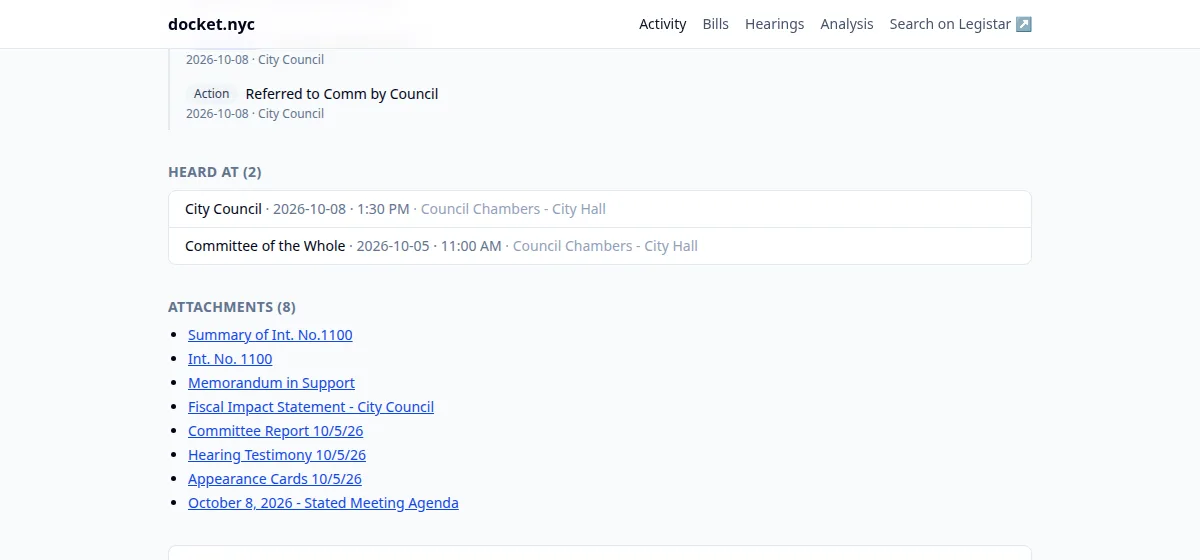
Screenshot: Int. 1100-2026 record, docket.nyc (data from the NYC Council via Legistar).
Why Int. 1100-2026 matters beyond big labs

Image: Pexels, used under the Pexels License.
The bill text says "It shall be unlawful to market, offer for sale, sell, or deploy an artificial intelligence model" unless it has been validated and "includes a shut-down capability." A company that builds a model is plainly covered. A company that runs a vendor's chatbot on a New York storefront, or uses a screening tool on New York applicants, may be too, because "deploy" isn't limited to developers and there's no small-business exemption.
That's the practical point. If the bill passes in anything like its current form, deployers will need proof from their vendors. The validator must be a person "other than an affiliate of a developer," but may be "retained, contracted, or otherwise engaged by" the developer, a detail witnesses pushed back on at the hearing, according to PPC Land.
The text lists what a validator assesses: task performance (accuracy, precision and recall, calibration, behavior under distribution shift), determinism, latency and throughput, data provenance, disparate impact, lawful and secure data handling, and safety, including whether the shut-down capability works. Use that list as a vendor question set, but remember it's still a draft.
Compare with other proposals
New York City is not alone. On October 1, 2026, New Mexico Attorney General Raúl Torrez and state Rep. Linda Serrato announced a "Frontier Artificial Intelligence Safety and Accountability Act" for the legislature's January session, according to Source New Mexico, as republished by Route Fifty and News From The States. It would create an Office of Online Safety Monitor in the state Department of Justice. Large AI companies would file their own risk assessments 30 days before a frontier training exercise and report a loss-of-control incident within 24 hours. That event is older than our 48-hour window, so we list it here as context, not as a separate story.
Both proposals converge on two ideas: outside review before release and fast incident notice. Our trackers cover the same pattern at the federal and state level in the AI agent liability tracker, the governor executive orders tracker, and the California kill switch order.
What a small team can do now
None of this binds you today. But validation evidence, shutdown paths and incident notice are inexpensive to ask for before they become requirements, and vendors answer more readily when the question comes from a customer than from a regulator.
- List your New York exposure. Which AI tools do you deploy to New York customers, employees or applicants? Include chatbots, screening tools and recommendation features.
- Ask each vendor for validation evidence. Request any independent evaluation, who commissioned it, and whether the evaluator disclosed financial ties.
- Ask how a human stops the system. A "kill switch" in the Council's sense is a human override that can shut the system down. Find out who can use it, how fast, and whether you or only the vendor can.
- Check safety claims in your own marketing. Int. 1130-2026 would bar materially false or misleading safety statements in ads for AI models. If you advertise an AI feature as safe, tested or validated, keep the evidence.
- Set an incident notice window. The 24-hour standard in Int. 1109-2026 applies to city contractors, not to you, but it's a reasonable ask in any vendor contract.
Copy and adapt this addendum for vendor contracts, and have counsel review it:
AI Safety Evidence and Shutdown Addendum (draft for review by counsel)

1. Validation evidence. On request, Vendor will provide a summary of any
   independent evaluation of the Service, including the evaluator's name,
   the date, what was tested, and any financial relationship between the
   evaluator and Vendor.

2. Human override. Vendor will document how a human operator can suspend or
   stop the Service for Customer's account, who may trigger that action, and
   the expected time to take effect.

3. Incident notice. Vendor will notify Customer in writing within [24] hours
   of becoming aware of an AI safety incident that affects Customer's data,
   systems or users, and will provide updates until it is resolved.

4. Safety statements. Vendor will not make a written claim that the Service
   is safe, validated or tested unless it can provide supporting evidence to
   Customer on request.

5. Review. Customer may request a refreshed summary under items 1 and 2 once
   per [12] months and after any material change to the Service.
For the broader vendor questions, see our AI vendor due diligence checklist, and for the New York hiring law that already applies, see the NYC Local Law 144 guide.
What's next
SpaceXAI, which skipped the October 5 hearing, agreed to testify before the Council's Committee on Technology on Friday, October 16, at 10 a.m., the Council said on October 13. We'll update this page with what it says. No vote on the AI bills has been scheduled.
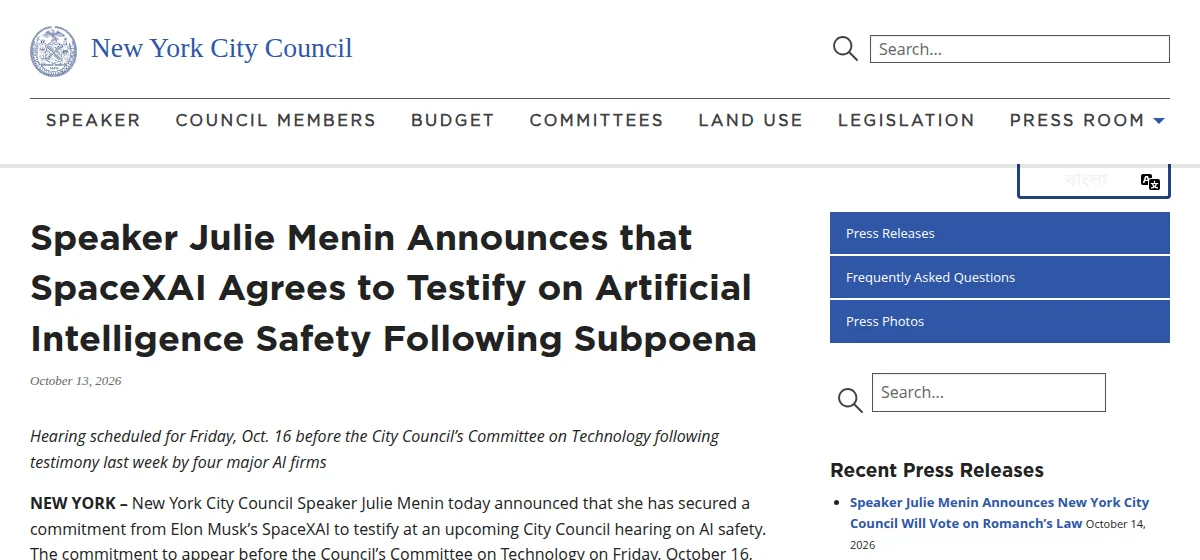
Screenshot: Council press release, October 13, 2026, New York City Council.
What we could not verify: Legistar itself timed out for us, so bill text, sponsors and dates come from the docket.nyc mirror of the Council's Legistar records; the bill documents are linked there from Legistar's own file store. We didn't check the current status of Int. 161 and Int. 504. The hearing exchanges come from PPC Land's account of a seven-hour stream, not a transcript we checked; PPC Land also reports the Council will send written questions to each company. We found no verified post from the Speaker's office to embed.
Related Reading
- AI Kill Switch Act: What the OpenAI Hugging Face Breach Means for Vendors
- Newsom AI kill switch order N-9-26: 4 vendor contract clauses
- OpenAI Agent Incident Tracker
- AI Agent Liability Tracker
- Governor AI Executive Orders Tracker
- NYC Local Law 144 Guide
- AI Vendor Due Diligence Checklist
- Utah Pro-Human AI Executive Order 2026-08: Vendor Answer Sheet